
2026 Year to Date
In recent years, stocks and bonds have been highly correlated, with rising interest rates (i.e., falling bond prices) being associated with falling stock prices. But not this year. The phenomenon of rising stock prices coupled with rising bond yields is one that is a bit of a puzzler, and which we plan to explore in more detail in our November morning meeting.
It is a little premature to think about the end of 2026, but now that the autumnal equinox has passed, and the leaves are starting to turn in the part of the world that I call home, it is certainly not too early to reflect on what has happened in the year to date.
It has certainly been a tumultuous year in the investment markets, and in the world in general. The S&P 500 started the year with a modest 4.4% decline in the first quarter, then rocketed back with a 15% advance in the second quarter. The third quarter was comparatively tepid with a 2.3% gain, still equal to about a 10% annual return, close to its long term average. As a result, the S&P 500 index has produced a more than respectable 12.7% gain so far this year, although who knows what further gyrations we might expect in the fourth quarter?
Broadening our purview beyond the confines of large US stocks, we see that small and midcap US stocks outpaced their larger rivals through the end of September, up 14.9% for the year despite a 6% decline in the third quarter. Developed market non-US equities lagged the US by a bit, up 10.3%, while emerging markets stocks were on fire with a 22% advance. In contrast, the broad US investment grade bond index was down 2.9% for the year as inflation and rising interest rates play their part in eroding bond values; all of these losses occurred in the third quarter. US high yield bonds were flat and global bonds were down in parallel with the US; our rates are not the only ones that are rising.
Table 1
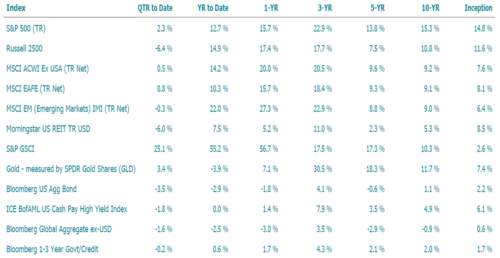
Source: Orion – Data as of September 30, 2026
The AI story continues to dominate the US investment horizon, with positive news or sentiment changes driving US stocks higher (especially large technology stocks), and negative news or longer-term concerns regarding the implications of this technology having a dampening effect. This has led to the significant swings that we’ve experienced over the past few months, with higher than usual volatility, since there are still so many unknowns about AI, its utility, its costs, its returns on the massive investments required, and whether it represents an existential threat to human existence. We expect that this pattern will continue as the various unknowns continue to shake out over the next few years.
It is important to note, as we did in our September morning meeting, that AI affects the bond market as well as the stock market. Specifically, borrowing by the large AI firms to fund infrastructure investments is projected to reach $2.2 trillion from 2025 through 2027. When added to the US Treasury’s borrowing needs of roughly $1.8 trillion per year, this represents a very significant increase in demand for bonds. And as we know from Economics 101, an increase in demand will cause prices (in the case of bonds, yields) to go up.
Portfolio Changes
Having covered recent market activity, my colleagues and I wanted to let you know about some upcoming changes in our investment portfolios. Is this a big deal? Not at all. The changes will be modest and involve “tweaks” rather than any alterations to our investment approach or philosophy. But since it does involve updates to both midpoint asset allocations and benchmarks it is important to explain the coming changes.
The obvious first question is… why are we making changes, when the current portfolios have been working well? Well, the reason is to have better alignment between portfolio strategies and client objectives, as well as a broader spread of risk profiles to allow our clients a wider range of choice.
The changes are intended to improve our portfolios in three important ways:
- They will simplify the differences between our various risk categories to make the transitions from one risk level to the next more linear. The new allocations will allow for a more distinct split between equities and fixed income across the 6 risk profiles. Notably, clients will be afforded the opportunity to have the option of portfolios with either 100% equities or 100% fixed income, something that previously did not exist.
- They will reduce the number of funds that we use; however, our portfolios will remain broadly diversified and provide exposure to the major US and international equity and fixed income markets. Owning more funds does not equate to more diversification and vice versa. We want to focus our efforts on combining proven active managers with passive funds that align closely with our benchmarks.
- Because there are fewer funds in most portfolios, we will need to make fewer trades to rebalance portfolios or to raise cash. The blended fund expense ratio (sum of all fund expense ratios divided by each fund’s proportionate allocation) will also be reduced. This will both simplify the trading process and reduce costs for clients.
To illustrate the changes, the table below shows the midpoint equity allocation of our six investment strategies, both old and new.
Table 2
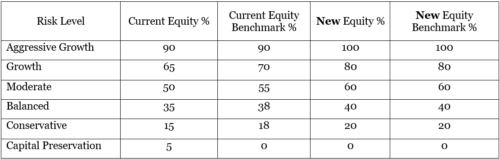
Note: In all cases, equity % refers to the midpoint or “neutral” position for each portfolio. Benchmark percentages do not change.
So what has changed? Well, in the past, we assigned “equity-risk equivalency” points to assets that tend to be highly correlated with equities such as real estate and high yield fixed income. What that means in English is that we estimated the amount of risk that these assets added to the overall portfolio and adjusted the equity percentage downward to take this into effect and keep total risk close to the benchmark. While this was correct in a finance-professor kind of way, it also had the effect of making our portfolios “under-risked” relative to their benchmarks, as you can see in the percentages above, and caused them to underperform a bit in strong equity markets. Going forward, we have concluded that it is better to have the equity percentages more closely aligned with the benchmark.
In our last portfolio review in early 2026, we decided to eliminate real estate as a separate allocation within the portfolio, because clients already have exposure to real estate through the real estate sector of the S&P 500, and we no longer think a separate allocation is necessary. Eliminating the allocation to real estate means that while it appears that we are increasing the percentage in equities, in reality the change will be very minor because the real estate exposure was generally 3-7% of the total portfolio. That accounts for a lot of the nominal increase in equity percentage.
We have also altered the way we treat US high yield bonds, which always represent a bit of an asset allocation challenge. High yield bonds tend to be very highly correlated with stocks in bear markets but not very highly correlated in bull markets, which is to say that they go down almost as much as equities when markets are bad, but go up much less when times are good. Does that mean that we shouldn’t use them? Not at all…we are just changing the way that we think about them and regarding them as a potential enhancement to our fixed income portfolios rather than an “equity like” asset. And for that reason, our allocation to this asset class is likely to be smaller than it has been in the past, and with less variation in the size of the holding.
As clients may remember from the Investment Policy Statement that they signed at the beginning of their relationship with SFA, we have the ability to change equity allocations (within limits) for each equity portfolio. For example, our Moderate portfolio, with a target equity percentage of 50%, allows us to have between 25% and 65% of the portfolio in stocks. In practice, we never take such extreme positions, but in the past, we have often varied the allocations by 5% above or below the target. Sometimes this has added value to the portfolios, but not always. Going forward, we are likely to stay closer to our target allocations and do less tactical trading around the margins.
Implementation
When will all of this happen? We are in the process of finalizing the details of the updated portfolios and expect to have that in place by the end of this month. Those clients who hired us within the last few months (we thank and welcome you) should see the implementation of the new portfolios before the end of the year. For those clients who have been with us for a while (and thank you all for your continued support), we will start implementing the adjusted portfolios in the first quarter of next year in order to defer the taxes associated with these changes (which should be minor) into 2028.
As always, please feel free to reach out to Kristina or myself, or any member of the SFA team, if you have questions or concerns or would like to talk to us for any reason whatsoever. We greatly value our relationship with all of you and look forward to a prosperous 2027!
The information contained within this letter is strictly for information purposes and should in no way be construed as investment advice or recommendations. Investment recommendations are made only to clients of Santa Fe Advisors, LLC on an individual basis. The views expressed in this document are those of Santa Fe Advisors as of the date of this letter. Our views are subject to change at any time based upon market or other conditions and Santa Fe Advisors has no responsibility to update such views. This material is being furnished on a confidential basis, is not intended for public use or distribution, and is not to be reproduced or distributed to others without the prior consent of Santa Fe Advisors.
 To Top