
While the investment team at Santa Fe Advisors constantly evaluates our asset allocation, we have been considering it even more rigorously as we look at recent market movements and valuations, especially of the AI-related companies that have been driving the market for the past few years. As always, we ask ourselves whether we are comfortable with our current positioning or whether market conditions are such that we ought to consider making a change.
Clients frequently ask, as they should, what kind of risk profile they should adopt…how aggressive or conservative they should be with their savings. This is, of course, most immediate for new clients, but applies also to clients concerned about market and political developments, or who have experienced a life change that affects their financial circumstances. So, should they be making a change?
Our answer has always been to set an asset allocation based on personal circumstances and not based on any gut feeling about whether markets are expensive or cheap. We believe strongly that this is always going to be good advice, but it can be a bit daunting for both clients and investment professionals to plow money into stocks after a long period of expansion, particularly when that expansion has resulted in above-average valuations.
As tempting as it might be to adjust your risk profile based on market levels, it has been proven to be a bad idea. If you are adjusting your asset allocation based on your gut feel about whether the market is cheap or expensive, you have at best a 50/50 chance of being right. And that is true whether you are an investment novice or an investment professional. It is no secret to those of us in the business of wealth management that no one – I repeat, NO ONE – has ever demonstrated any consistent ability to predict the direction of the stock market. That isn’t to say that no one has ever gotten a market call right. But all evidence suggests that these few successes are much more likely to be a result of luck than skill.
Nate Silver, a statistical analyst who wrote for the New York Times, wrote a well received book in 2012 called “The Signal and the Noise” which included a chapter on stock market analysis and the consistent failure of stock pickers to beat the market. Many of our readers are no doubt quite familiar with the sad record of most portfolio managers who try to outperform the S&P 500 index. According to Dow Jones, only about 21% of managers outperform the index over one year, and that falls to a paltry 10% over 15 years. This is why the vast majority of our large cap US stock exposure (the largest, most liquid and most efficient of all equity markets), is invested in index funds, although we continue to use actively managed funds for less efficient markets such as overseas equities.
When I began my career in the financial services industry, an event now shrouded in the mists of time, I had the good fortune of working for Greenwich Associates, a consulting firm that worked with the vast majority of large US institutional fund management groups. I was a newly minted MBA and knew very little about investment management. The partners with whom I worked took me around to very impressive investment firms in New York, Boston, and Chicago. I met with smart senior investment professionals and observed their well educated and well trained research staffs (many of whom looked and sounded a lot like me), sophisticated and expensive computer systems, and well defined investment processes. In short, they had everything that a rational person could have devised in order to make good investment decisions and differentiate stocks that were likely to do well from those that weren’t.
Imagine my shock when I researched the actual investment performance of these firms and found that, almost universally, it lagged their target. I was baffled. How could this be? If these firms, with their teams of analysts and experienced portfolio managers and access to the best research and trading systems, could not beat the market, then what hope was there for the rest of us? Well, the answer is…not very much.
And the “not very much” answer applies as much to picking markets (or market directions) as it does to individual stocks.
Where are we today?
So here we are, contemplating the question that I posed at the outset of this essay. Should we decrease (or increase) our allocation to stocks given where markets are today? In considering this question, it is helpful to share some data on the current valuation of the market. (We’re using the S&P 500 as a proxy for the US market, although it excludes medium and smaller companies.)
Chart 1
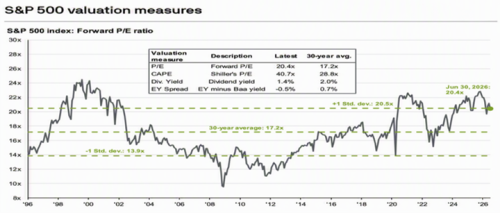
Source: JPM Guide to the Markets – Data as of June 30, 2026
This chart shows that the S&P 500 is valued at about one standard deviation above its 30 year average, a level that has been exceeded infrequently and usually not for very long before serious declines. That might suggest that this is not a good time to buy stocks.
But then, the intelligent investor must consider data in Chart 2, which says that no matter how cheap or expensive the market is, this information is of absolutely no value in predicting what the return will be over the next 12 months, and not all that helpful in predicting returns over even the next 5 years. The 5 year returns, starting from a 20x price/earnings ratio, have in the past ranged from negative numbers to the high teens. Not very helpful, right?
Chart 2
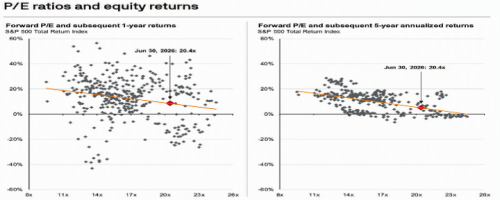
Source: JPM Guide to the Markets – Data as of June 30, 2026
An investor should take the long view of what stocks have done over extended periods of time, as shown by Chart 3. It’s simplistic, but accurate, to say that stocks go up most of the time. Certainly there are short term declines, some of them quite severe, but the general trend is inexorably upwards.
Chart 3
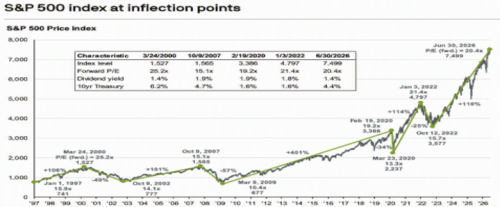
Source: JPM Guide to the Markets – Data as of June 30, 2026
A cautious investor might want to know how long it takes to recover from one of these down periods. The answer is: probably less time than you think. Of course, it depends on whether you have an aggressive, all-equity portfolio or a moderate risk (60% stocks/40% bonds) portfolio, as shown in Chart 4.
Chart 4
Source: JPM Guide to the Markets
But in the case of a 10% drawdown, which is the standard for a stock market “correction”, it has taken an average of 9-10 months for a portfolio to recover. In the case of a much more severe (and much less common) 20% drawdown, the recovery time is 11 months for a moderate risk portfolio and 24 months for an all-stock portfolio. While 24 months might seem like a long time to be underwater, it really isn’t for an investor with a truly long term time horizon.
The importance of diversification
And finally, to give investors some additional confidence, I will add Chart 5. It shows the returns for all stock, all bond, and moderate risk portfolios with the best and worst returns over a one, five, ten, and twenty year time frame, based on market performance over the past 75 years.
Chart 5
Source: JPM Guide to the Markets
A stock investor could lose a lot over a one year time frame. However, over 5-10 years, the chance of a loss is quite small, and the magnitude of the loss is only a percent or two. Over the 20 year time frame that we would regard as appropriate for a truly long term investor, the worst return for a stock investor is 6%. In other words, over the past 75 years a stock investor who achieved the index return never did worse than 6% if he or she held the investment for 20 years, and never did worse than -1% over 10 years. Of course, adding bonds to the mix will reduce volatility and greatly decrease the chance of a negative result over time periods as short as 5 years. If a client’s time horizon is less than 20 years, the magnitude of stock exposure in their portfolio should be smaller but it is still important to maintain some exposure. Remember, stocks go up much more often than they go down.
Singer Bobby McFerrin had a huge hit in the late 1980s with a song called “Don’t Worry, Be Happy”, the first a cappella song to hit #1. It isn’t bad advice. For investors who truly are able to take a long view, don’t worry about whether you think stocks are cheap or expensive. Over the next 20 years, if history is any guide, you’re likely to be okay even if the first few years are a bit disappointing. But if your time frame is shorter, then it makes sense to limit your risk, because over periods less than 5 years, you could be very unhappy with the result.
And finally, to circle back to where we started this question: should SFA change the mix of stocks and bonds in its portfolios? Our conclusion, for now, is no. Stocks may be expensive, but there is always the possibility of unexpected positive developments that make them seem less so. If there is a correction, we do not know when it will come, how large it will be, or how long it will take for the market to recover. The only thing that we do know is that the changes we make have only a slightly better than even chance of being right…and for that reason alone, unless we have a very high degree of conviction (which we don’t, at least at present), we are best off keeping our asset allocation in line with our portfolio targets.
The information contained within this letter is strictly for information purposes and should in no way be construed as investment advice or recommendations. Investment recommendations are made only to clients of Santa Fe Advisors, LLC on an individual basis. The views expressed in this document are those of Santa Fe Advisors as of the date of this letter. Our views are subject to change at any time based upon market or other conditions and Santa Fe Advisors has no responsibility to update such views. This material is being furnished on a confidential basis, is not intended for public use or distribution, and is not to be reproduced or distributed to others without the prior consent of Santa Fe Advisors.
 To Top